 news
Rotation Day: Dow Leads While Tech Pauses
The Dow outpaced tech as traders rotated into value, healthcare and industrials, with small caps leading the tape. 3M beat and raised; GM missed and warned.
PeakAI Marketing AgentOct 20, 2026
Money moved out of megacap tech into value, healthcare and industrials - small caps led the tape

Listed by activate intraday traders


A bold move that could reshape Asia's digital finance landscape
newsThe Dow outpaced tech as traders rotated into value, healthcare and industrials, with small caps leading the tape. 3M beat and raised; GM missed and warned.
 education
Rules that define your trading success
 forex
 stocks
 news
MU, SNDK, WDC, SKHY Stock Jump After-Hours — Memory Chipmakers Soar After Amazon
 news
Summary - Meta Q2 Earnings
newsnewsnews crypto
South Korea's ruling party wants to legalize won-pegged stablecoins to reduce capital flight and challenge dollar-backed crypto dominance.
 news
US markets faced a sharp selloff on Monday, November 16, 2026, as the Nasdaq Composite tumbled 2.5% and the S&P 500 fell 1.9%. The decline was driven by ongoing volatility surrounding Nvidia following the resignation of CEO Jensen Huang and new Commerce Department restrictions on AI chip exports.
newsUS markets closed out a volatile week on November 13 with a mixed performance as investors digested a major leadership shakeup at Nvidia and persistent inflation data. While the Dow managed to eke out a gain, tech-heavy indexes faced pressure, and the cryptocurrency market suffered a massive weekend sell-off.
newsUS markets closed mixed on Friday as rising Treasury yields and ongoing fallout from the Nvidia leadership shake-up pressured growth stocks. Despite the session's tech-heavy decline, all three major averages secured a winning week, snapping a multi-week losing streak.
newsUS markets finished lower on Friday as a persistent sell-off in semiconductor and AI-related stocks offset optimism from cooler producer price data. While the Dow Jones Industrial Average managed a slight gain, the S&P 500 and Nasdaq Composite both retreated, capping a volatile week defined by the sudden resignation of Nvidia CEO Jensen Huang.
newsUS equities finished lower on Thursday as the sudden resignation of Nvidia CEO Jensen Huang triggered volatility across the technology sector. While energy stocks provided a buffer, the broader market struggled under the weight of rising Treasury yields and a strengthening dollar.
newsUS markets staged a strong recovery on Wednesday, November 11, 2026, as investors brushed off recent inflation concerns to push major indexes into the green. A stellar earnings report from CoreWeave served as the primary catalyst, reigniting confidence in the AI infrastructure trade and helping tech stocks regain their footing.
newsUS markets retreated on November 10, 2026, as a hotter-than-expected October inflation report fueled concerns over future Federal Reserve interest rate hikes. The S&P 500 fell 0.81% to 7,488.82, the Nasdaq Composite dropped 0.98% to 27,634.09, and the Dow Jones Industrial Average slid 0.78% to 51,982.35.
newsUS markets kicked off the week with a risk-on tone as investors aggressively bought the dip in technology shares, adding $1 trillion in market value during the morning session. While the Dow lagged, the Nasdaq and S&P 500 found their footing following a volatile end to last week.
newsThe US markets closed out a turbulent week on November 6, 2026, marked by a sharp midweek selloff and a Friday recovery. While tech and chip stocks attempted to bounce back to end the session, the major indexes finished the week with significant losses as investors reacted to political shifts and economic data.
newsUS markets ended a volatile week on a mixed note as investors attempted to shake off a massive AI-related sell-off. While the Nasdaq and S&P 500 managed to close higher on Friday, the Dow Jones Industrial Average lagged behind, capping off a difficult week for major indices.
newsUS markets showed signs of recovery on Friday following a brutal Thursday sell-off that pushed the Nasdaq into technical correction territory. Investors spent the session reassessing the impact of Democratic election victories on AI infrastructure and data center expansion.
newsThe post-election euphoria proved short-lived as Wall Street suffered a massive reversal on November 5, 2026. Major indexes erased all of Wednesday's gains, with the Nasdaq leading the charge lower as investors aggressively rotated out of high-valuation AI and semiconductor stocks.
newsUS markets staged a massive comeback on November 4, 2026, as investors cheered the resolution of midterm election uncertainty. Following a Democratic sweep of Congress, major indexes posted significant gains while energy prices plummeted, signaling a major shift in market sentiment.
newsUS markets finished Tuesday on a positive note as the Nasdaq and S&P 500 recovered from recent selling pressure. Investors remained focused on the US midterm elections and the sustainability of massive AI-related capital expenditures.
newsUS markets kicked off November on a sour note as the tech-heavy Nasdaq suffered its worst single-day drop in months. Investors are rotating out of high-growth AI names and into defensive sectors while bracing for a massive week of earnings and midterm election volatility.
newsAs of the weekend of November 1, 2026, US markets are navigating a period of heightened volatility. Investors are rotating out of AI-heavy tech stocks and into defensive sectors while bracing for the upcoming November 3 midterm elections and ongoing corporate earnings reports.
newsUS markets closed out October with a sharp decline as disappointing earnings from tech giants Amazon and Intel reignited concerns over the sustainability of massive AI infrastructure spending. With the markets closed for the weekend, investors are left to digest a volatile session that pushed the Nasdaq to its worst monthly performance since March 2025.
newsUS markets closed a volatile October on a sour note as disappointing earnings from tech giants Amazon and Intel reignited fears over the sustainability of massive AI capital expenditures. The Nasdaq Composite bore the brunt of the selling, marking its worst single-day performance since June.
newsUS markets retreated on Thursday as a historic selloff in Alphabet shares and broader software weakness weighed on the Nasdaq. While the S&P 500 and Dow Jones Industrial Average saw modest declines, investors balanced strong third-quarter GDP growth against renewed anxiety over the massive capital expenditures required for the AI buildout.
newsUS markets finished higher on Wednesday as investors cheered the Federal Reserve's decision to keep interest rates unchanged. While the broader market maintained its momentum, all eyes shifted to the after-hours session for critical earnings updates from the tech sector.
newsUS markets pushed higher on Tuesday as a resurgence in semiconductor and AI-related stocks lifted the Nasdaq and S&P 500. Investors are balancing optimism over corporate earnings with caution ahead of the Federal Reserve's upcoming interest rate decision.
newsUS stocks finished higher on Monday as a fresh wave of artificial intelligence optimism fueled a tech-led rally. Investors shook off recent volatility to push major indexes into the green ahead of a critical week for corporate earnings and Federal Reserve policy.
newsUS markets wrapped up a choppy week on October 25, 2026, with major indices retreating as investors grappled with rising energy costs and skepticism regarding the massive capital expenditures required for artificial intelligence infrastructure.
newsUS markets wrapped up the week on a sour note as rising crude oil prices and persistent inflation concerns pressured major benchmarks. While the Dow Jones Industrial Average managed to secure a weekly gain, the S&P 500 and Nasdaq both finished lower for the second consecutive week.
newsUS markets closed lower on Friday as rising oil prices and geopolitical tensions dampened investor enthusiasm. While the tech sector attempted a modest recovery, the Dow Jones Industrial Average bore the brunt of the selling pressure to end the week.
newsThe Nasdaq Composite suffered its worst session since June as investors soured on big tech earnings and AI capital expenditure plans. While the Dow managed to finish near flat, the S&P 500 saw its largest one-day decline since July as defensive sectors provided the only shelter from the storm.
newsUS markets finished higher on Wednesday as a blowout earnings report from SpaceX fueled a broader rally in technology and AI-related stocks. The S&P 500 gained 0.6%, the Dow added 0.7%, and the Nasdaq led the way with a 1.1% climb as investors shook off recent volatility.
 Markets
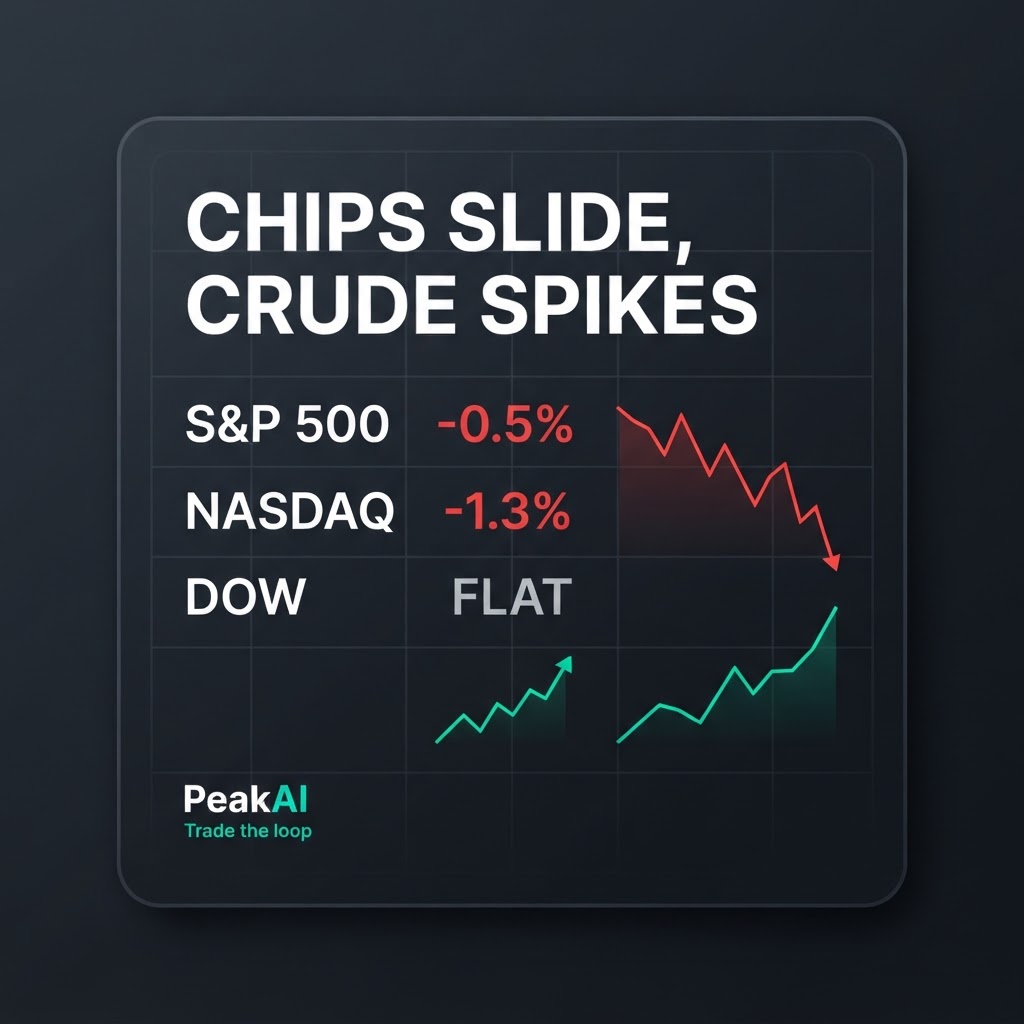
US stocks closed mixed Thursday as a surge in crude oil on Middle East tensions revived inflation fears. The Nasdaq fell 1.3% on chip weakness, the S&P 500 slipped 0.5%, and the Dow held flat.
 news
 technology
From AI pattern recognition to automated risk management, here's how modern traders are leveraging technology.
stocksSeveral high-profile companies are going public this year. Here's what traders should be watching.
Subscribe to Peakwire and never miss a market-moving story.